
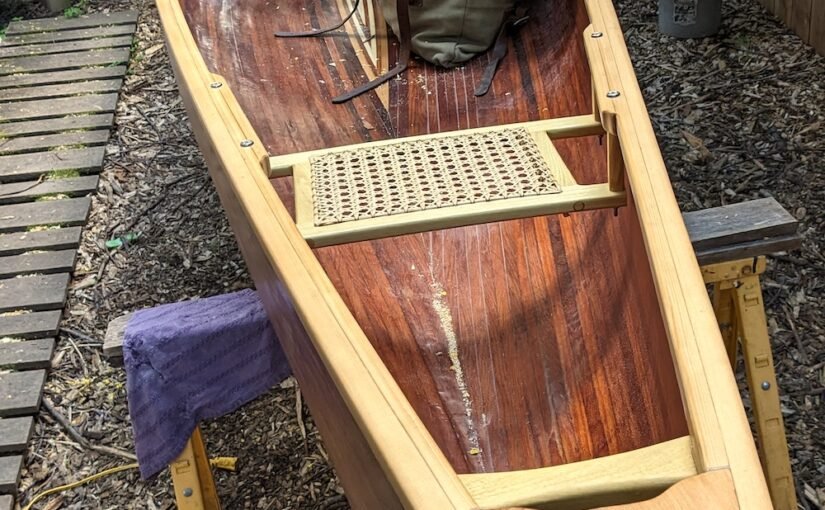
A few companies sell plywood boat kits. Pygmy was one of them. Chesapeake Light Craft is still selling. These kits include pre-cut parts, plus hardware, and complete instructions. If you can build a Lego set or an Ikea bed, you can build one of these kit boats.
Chesapeake will even sell you a cedar strip boat kit, but with a warning: These models require more patience and are best suited to builders with some prior boatbuilding experience… The warning continues: Typical strip-boat manuals provide general guidance and leave some details to the builder’s interpretation.
When Janell and I built our cedar strip canoe, we found that a home-built canoe is a series of mistakes, followed by imperfect solutions (Chesapeake calls this the builder’s interpretation). No matter how many YouTube videos we watched or how-to books we read, we still improvised.
Improvisation is in my comfort zone. I’m okay with making mistakes if I can fix them later. But how do I feel about changes with no “undo?”
Placing the Bow Seat

In deference to the disgreement in terminology (see “thwarts“), the bow seat is in the front (bow) of a canoe. The back end of a canoe is called “stern.” The bow paddler needs room for their legs and occasionally an adventure dog.
When Janell and Rich (fellow builder) decided on the placement of the bow seat, they used the sparse instructions we had scrounged up, plus a reasonable guess, plus four inches. (Four inches just because.) They glued and screwed the gunnel reinforcements according to that educated guess, and that’s where I hung the seat.
Sadly, after sitting in the boat, we realized this was still too close to the bow. This made the boat tippy and cramped. We needed to move the seat back, but this would mean some serious gunnel surgery. Gunnels are those highly visible strips around the outside of the boat, adding both structure and beauty. Because of their visiblity, there is no graceful way to undo a mistake.
With reservations, we decided the possibility of cosmetic damage was worth the probability of improved functionality. Using trial and error, we chose to move the front of the seat to the back attachment points already existing in the gunnel (about 61 inches from the tip of the bow). It also meant adding a gunnel reinforcement to hold up the back of the seat.
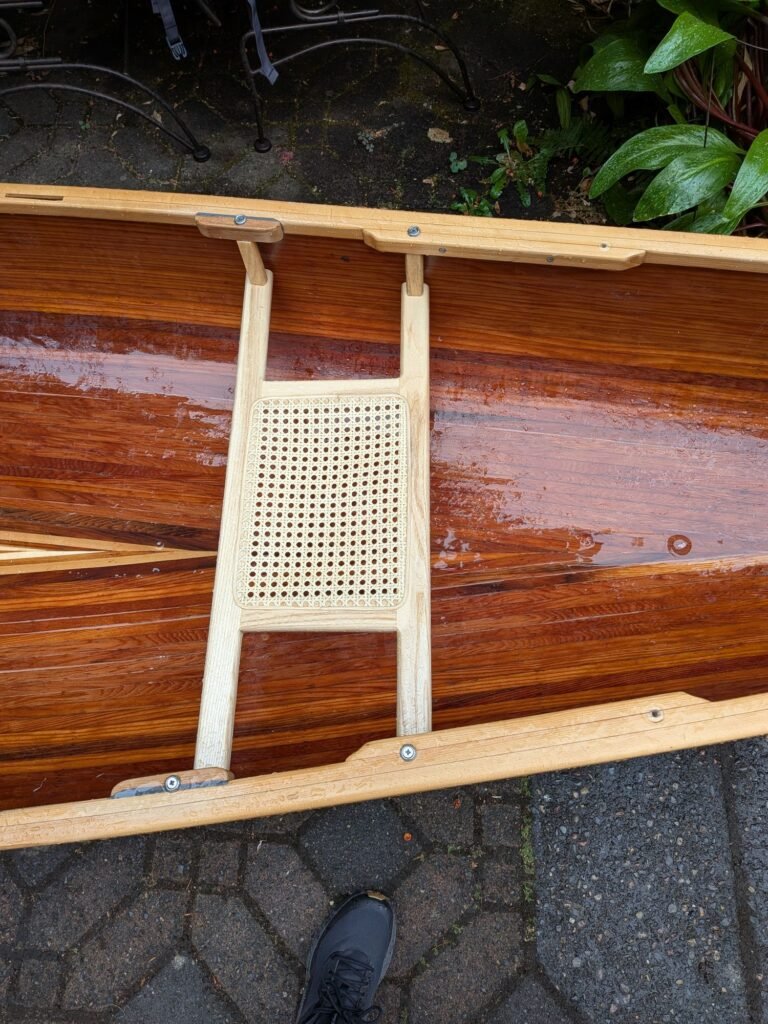
In the above photo, you’ll notice the original (long) gunnel reinforcement is still in place. I should have removed the reinforcement in front of the seat, but didn’t. Leaving the original reinforcement untouched meant I could return the seat to its original position. Its a feeble attempt at undo.
I explained to Janell how this was a satisfactory solution, but she did not agree. The ends of the existing reinforcements are exactly where her knees lean against the gunnel. Uncomfortable and no bueno!
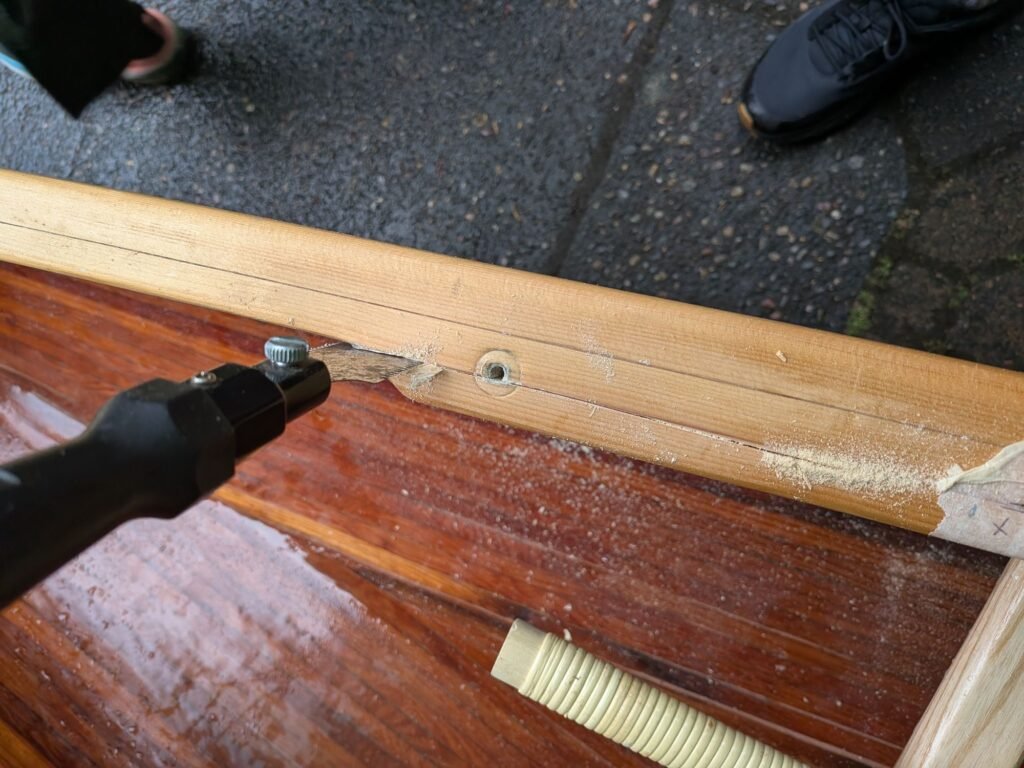
The correct solution would be to trim the long supports to look like the back supports. Which means saws, chisels, or lots of 60-grit sandpaper. None of those actions can be reversed. So here I am, out of my comfort zone.
Commitment
Many of my former peers in the software industry dreamed of starting their own company and making big money. Which meant throwing away your current high-paying job (my comfort zone) and stepping off into a risky entrepreneurial abyss. A few made it big. The rest hit the ground (hard). Entrepreneurs must be willing to throw everything into an effort they can’t gracefully back out of. Do or do not. There is no try.1
In this way, our boat is entrepreneurial. The cost of failure would be an ugly blemish to an otherwise beautiful boat, but it’s an all-in situation. It is unnerving to take a saw to the gunnel. Look at all the sawdust. Look at the ugly groove. Once you start with the saw, you can’t stop.
Maximizers and Satisficers
Psychologists talk about maximisers and satisficers. Maximisers strive to make a choice that will give the maximum benefit. Satisficers (a portmanteau of ‘satisfying’ and ‘sufficing’) make a decision to satisfy their criteria, even if it means not exploring every option. Janell is a maximiser, I’m a satisficer. When we go to restaurants, I see a menu full of equally satisfying options. Janell is looking for the best possible meal. When faced with a problem, Janell likes to explore all possible solutions, looking for the best choice. In contrast, I take the quickest path to an acceptable solution.
For example, we recently installed a ceiling fan in our bedroom. I had it wired and operable, but after watching it for a day, she wanted to try a different model. I pushed back; After all, the fan moved air around, what more could be expected? I was satisfied. But I’ve learned to embrace the process; she was right, the new fan provided better lighting, more speeds and better esthetics.
With the gunnels, I was satisfied with the long supports. But without Janell’s maximizing, the canoe would be uncomfortable for legs (and adventure dogs.) So I proceeded with the saw.
I chose to make this cut with a handsaw instead of a powersaw. The cut took longer, but I had more time to watch how it was progressing. Is it on the line? Is it vertical to the gunnel? Forget all the measurements; does it look right? A canoe has very few right angles and parallel lines; it’s all curves and bumps. That means I can use a square to approximate where the cuts should be, but as I cut, I need to make sure the approximation looks right to the boat.
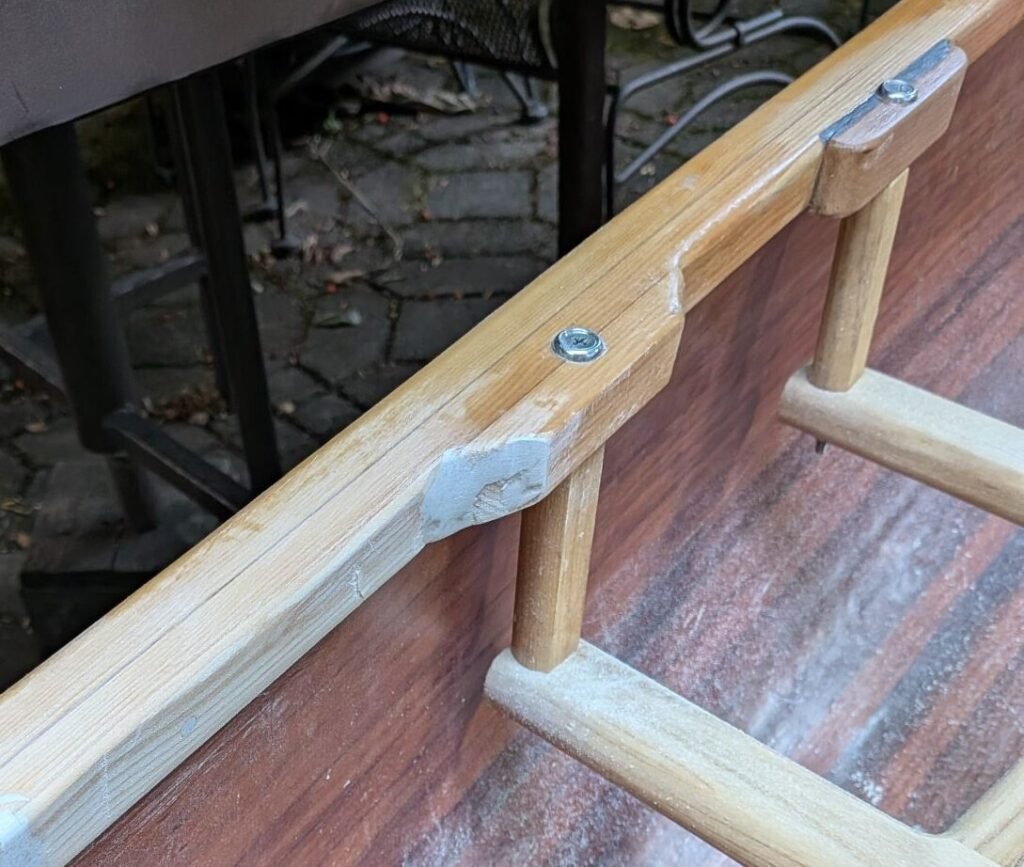
Overall, the surgery went well. But if you know what to look for, you’ll see evidence of my trespass.
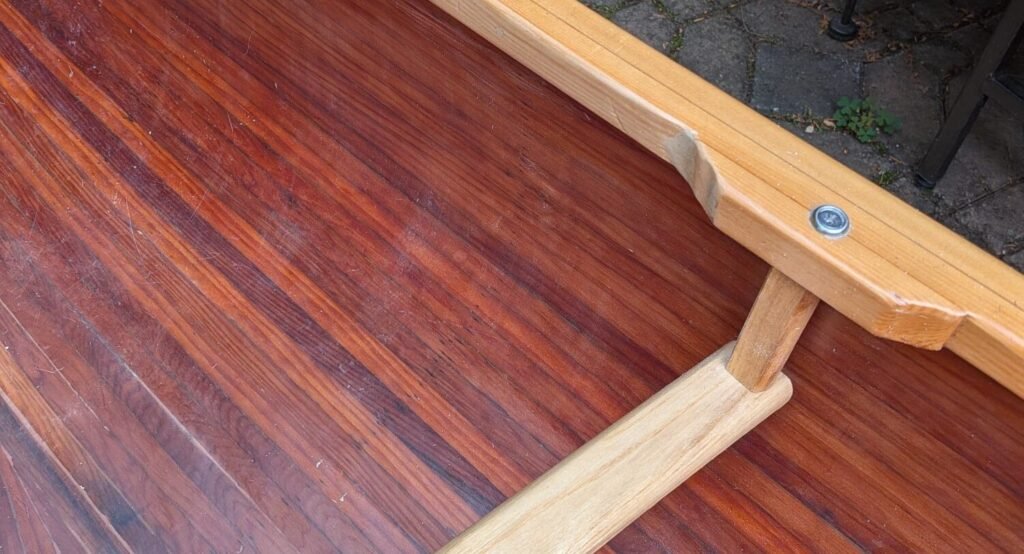
This canoe is a beautiful piece of furniture. But furniture has to serve a purpose or it’s just a pretty doorstop. Repositioning the bow seat leaves a blemish in the furniture, but the tradeoff for comfort is worth it.
Not surprisingly, our canoe reflects our marriage: a series of satisfying improvisations and maximized solutions. After forty years, we’ve learned to trust the process, even when we can’t see the undo.
- Yoda, Star Wars: Episode V – The Empire Strikes Back ↩︎